Retailer Strategy: 4 Types of Persuasion
Is a shopper need truly distinct from a shopper want?
A previously penned post on the distance between the heart and the brain certainly suggests so about consumer psychology. And now, having understood the emotions that drive purchase for frequent shoppers, its logical to examine how retailers react and position themselves to the very same shopper needs.
The role of a retailer is to persuade purchase. In certain times, persuasion is more necessary from a value perspective. Yet, even in affluent times, persuasion is necessary to hypnotize eager shoppers to make more than just required and meaningful purchases (which sometimes result in shopping blunders when a credit card bill leaves one wide-mouthed). I believe that in some cases, the type of shopper emotion seems to dictate the level of persuasion.
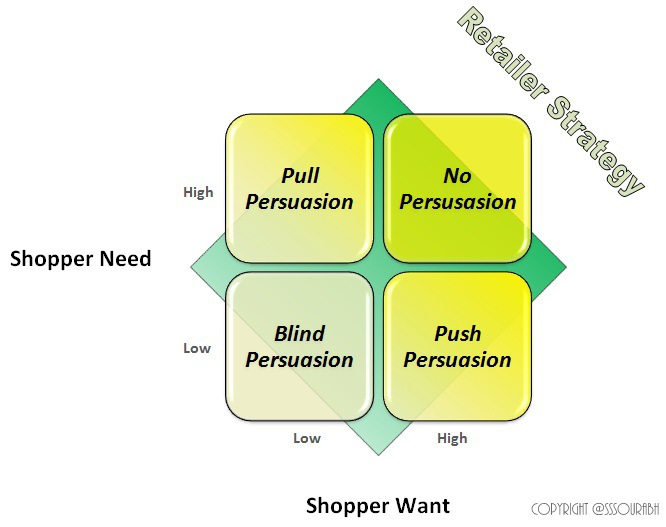
Blind Persuasion: For the equivalent of the love emotion, retailers conjure strategies embodying severe discounts, freebies, gifts-with-purchase, and the likes. Blinding shoppers with the hypothetical value they are getting, it is often quite a good deal, but one that was neither needed, nor wanted in the first place! Retail management courses have often taught of the layout of grocery stores, retail stores, etc., whereby enticing items are placed at checkout, or sale items are kept at the back of the store, as are grocery essentials like dairy, so that our unstoppable shopper eyes see much much more than necessary. The strategy works for retailers since they sell the bulk to momentarily love-lorn blinded shoppers. All of it.
Pull persuasion: For the almost emotionless requirement, the consumers are likely to pull the products towards them due to the inevitable need for the purchase. It is not necessary to elevate this need to a want, or to cater to the emotional aspect too much. This is where retailers can utilize the pull strategy to create singular deals. As this is a requirement, no extra effort is needed from a retailer perspective to engage interest, although some knowledge delivery is necessary. Weekly discounts at stores like Home Depot or IKEA fulfill this quadrant; consumers there are most likely buying requirement items, pulling these towards themselves, and singular deals can elevate the purchase volume.
Push persuasion: Package deals are pushed towards consumers, either by the pricing attraction or the physical store placement, thereby enticing shoppers. Since this arena of products is already something that shoppers crave, retailers can push the glitzy promotional material towards them. Besides a plethora of glossy, attractive and aspirational advertising, package deals come in handy, as do gifts with purchase (GWP). Getting a gift card with a purchase, or a host of related freebies, all fall into satisfying this quadrant. The world of glorified advertising rules the retailer strategy.
No persuasion: As Oscar Wilde says, you can resist anything but temptation. Indeed, for that which is high on a desire list, is often not on sale. Although, sometimes it may be, but is probably in limited quantities. The scarcity makes the product more valuable, almost masking the need and want all at once, but enticing shoppers to purchase it. This makes it more than simply a requirement, more than an itching craving, transforming it into a burning desire that drains pockets, trickles time in lines, and sometimes also satisfies. Think of holiday lines, the rush in stores on peak times, the limited time Amazon lightening deals or morning-only Black Friday and Boxing Day ones, and the gratification of getting the good deal on the last item. The retailer wins again!

What is your emotional driver for shopping? Seek your passion for shopping, and check to see how the retailer is catering to you, giving you options, but also enticing you to purchase more based on your emotion. Think about what you are shopping for, particularly during the holiday season. It has become a cat-mouse game these days, and some label holiday shopping as capitalism! Controversial for sure, but the truth is that retailers are getting more coy, somewhat more desperate, and ferociously competitive, since the shoppers have become less gullible, more frugal, influenced by social media to investigate the nooks of everything they buy, as I have spoken of in documenting how complex a modern shopping trip has become. Consumers have thus inevitably somewhat smarter (a smart consumer? It is a retailer’s biggest dilemma).